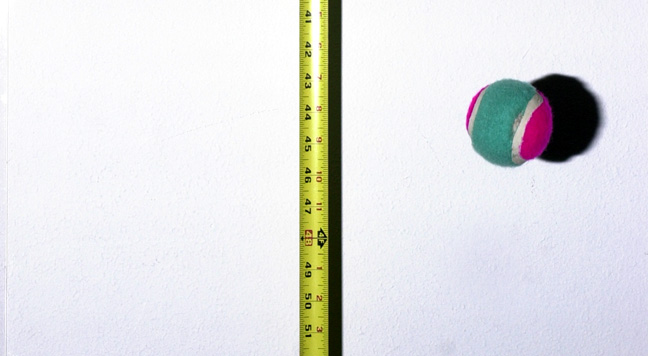
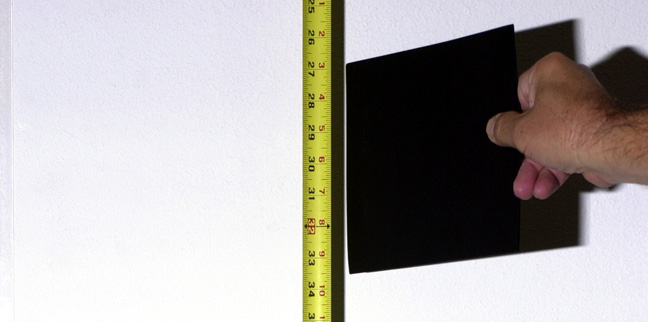
The Action-Sensor has a minimal delay (microseconds) in sending a trigger signal to a camera. However, most digital cameras do have a delay from the time the trigger signal is received until the photograph is taken.
A simple test can quickly determine the camera delay. The Nikon D1 or D1h cameras, for example, have a delay of about 70 milliseconds. An object traveling at 10 miles/hr would travel about 1 foot during that delay interval.
The setup to measure the camera delay is simple. Just position the Action-Sensor in the 'Night Mode' operation with a light source shining into the sensor. Position a tape measure from the ceiling of a room and focus the camera under test on the tape measure. Click HERE to see an example of the setup.
The camera should be set as it would be during an actual operation. We generally recommend all manual settings with a shutter speed of at least 1/1250 seconds. We did not find any significant difference in measurements if we used the 'Cable' or 'Wireless' Connection methods. Click HERE for additional connection details.
Determine the exact distance from the ceiling where the Action-Sensor triggers the camera by moving an object slowly down until the camera snaps the picture. Click HERE to see an example. We recommend adjusting the Action-Sensor so it triggers about 35 inches from the ceiling.
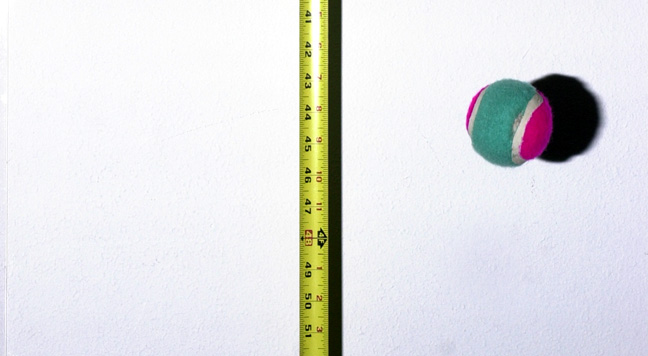
Now drop a tennis ball from the ceiling such that the Action-Sensor triggers the camera as the ball falls past the trigger point. Make sure the tape measure starts at the bottom of the ball as it is held near the ceiling.
Repeat dropping a ball 5-10 times since many cameras vary in their delay time.
Record the results from the photographs the camera takes of the ball and perform some simple calculations as is shown in the following table to determine the trigger delay of your camera. We have also included the original Excel file where you may want to substitute your values and the calculations are done for you.
CAMERA DELAY CALIBRATION

Nikon
D1 and D1h Action Sensor Offset Test Data
Camera Type & Setting ->
Nikon D1 Single Shoot
Nikon D1h Continuous
Shoot
Nikon D1h Single Shoot
Drop
Drop Time
Delta Time
Drop
Drop Time
Delta Time
Drop
Drop Time
Delta Time
Distance
Distance
Distance
Trigger
Height (Calibration)
33.500
0.418
Drop 1
45.750
0.488
0.070
46.250
0.491
0.073
46.825
0.494
0.076
Drop 2
44.875
0.483
0.066
47.500
0.497
0.080
46.250
0.491
0.073
Drop 3
45.375
0.486
0.068
47.250
0.496
0.078
45.750
0.488
0.070
Drop 4
44.250
0.480
0.062
47.000
0.495
0.077
45.750
0.488
0.070
Drop 5
45.250
0.485
0.068
47.000
0.495
0.077
47.625
0.498
0.080
Drop 6
45.750
0.488
0.070
46.500
0.492
0.074
45.250
0.485
0.068
Drop 7
44.625
0.482
0.064
46.750
0.493
0.076
47.250
0.496
0.078
Drop 8
45.375
0.486
0.068
46.500
0.492
0.074
46.250
0.491
0.073
Average Values of Data ->
45.156
0.485
0.067
46.844
0.494
0.076
46.369
0.491
0.074
Action Sensor offset for
inches -->
11.837
13.417
12.975
object moving at 10mi/hr
10mi/hr = 176 in/sec
Drop
Time = SQRT(2 x Drop Distance /
32ft/sec^2)
Delta Time
= Drop Time - Drop Time to Trigger Height
CONCLUSION
Our Nikon D1 and D1h cameras had a trigger delay of about 70 milliseconds. If we were to photograph some object crossing the finish line at about 20 miles/hour, we would move the Action-Sensor about 2 feet before the finish line to photograph whatever is finishing just as it crosses the finish line. We would also pre-focus our camera not at the Action-Sensor trigger line but 2 feet after that trigger point.